

I know that a lot of people are going through some rough circumstances right now; some are living in long, difficult seasons. It’s probably safe to say that most of us are dealing with at least something hard in our lives or in the lives of those we love…and if we’re not – spoilers – we will be soon. Such is life, right? It’s just the way this world is. Stained by sin. Even good things get warped and twisted by the effects of sin. Evil is trying to encroach upon everything that’s right, and in many places it seems to be all too successful. So there’s pain and struggle and sorrow and hardship, and we all wade through it to some degree just about every day. And on the days we don’t wade through pain and struggle and sorrow and hardship, we wade through (or swim in) our own pride and self-sufficiency and complacency. There’s always something (more likely lots of somethings) trying to keep us from trusting God.
But God is trustworthy. He tells us in His Word what’s true. He shows us the reality beyond our circumstances. He reveals who He is and what He’s doing in us and what He has planned for us. He gives us solid ground to tether us to that reality and hold us steady, even when the storms and waves roll in. He gives us a sure hope, a confident expectation we know we can truly count on no matter what.
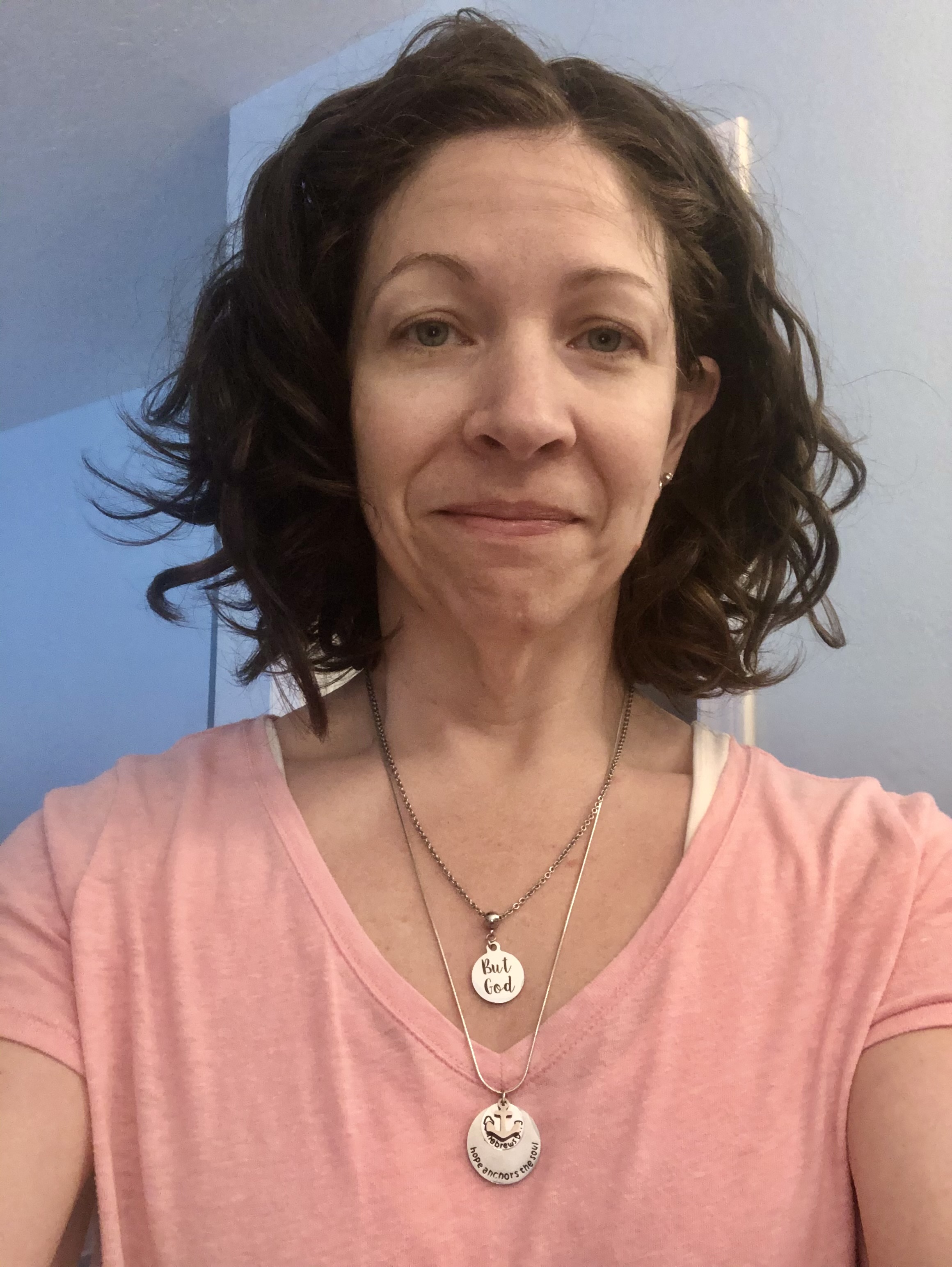
There are certain phrases and concepts in Scripture that are repeated throughout – phrases and concepts that we can and should cling to when life is hard, and when it’s easy. “The Lord is merciful and gracious.” “His steadfast love endures forever.” “Holy, holy, holy is the Lord God almighty, who was and is and is to come.” “Do not fear.” “But God.” I wear that one around my neck most days. It’s one of my favorites. I’ve written about it a little and I use it a lot. When things go wrong, when things are messed up, when I look back at mistakes I’ve made and when I look around at the messes of the world – when I don’t see how things can be okay, I can say “but God.” He is at work, He is not surprised, He is bringing about good. He can use anything and everything for good. He’s that good. That’s such a wonderful truth!
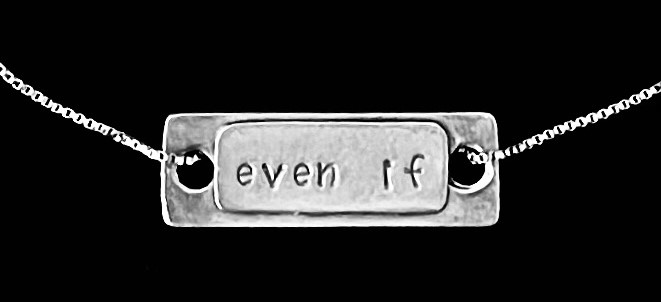
I have another necklace with a different biblical phrase on it. This is the one we’re going to focus on today: “Even if.”
“But God” is for the past and the present. We look back and we look around, and we can say “But God.” He can work it all together for good. “Even if” is for the times we’re looking – or trying to look, rather – into the future. It’s for those of us who are worriers, who tend to be anxious, who are often overthinkers. We think about what might happen, we stress over what could be coming, we keep ourselves up at night borrowing trouble and rehearsing what may never be – things we have no control over – and when we catch ourselves doing that, we can stop and say: you know what? Even if. I know the God I serve, I know the God who saved me. And even if He doesn’t work things out the way I want Him to, I know He’s going to work things out for good. And then we can breathe again.
I wore this necklace and was very glad for the reminder when I had to travel by airplane with a newfound-but-thankfully-temporary fear of flying (or, more accurately, a fear of falling). I knew it represented the truth of God’s goodness, and while it didn’t make me enjoy that flight, it did bring me peace through the stress. Because I knew that even if things went wrong, I wasn’t out of God’s hands.
The actual phrase “even if” is only found in Scripture a couple of times, depending on your translation, but the concept is shown over and over, and its use is exampled for us throughout the whole Word. Rehearsing what Scripture repeats for us, reminding ourselves and each other of what God tells us, finding ways to keep these truths in our minds throughout our moments – this is how we renew our minds and walk in His ways. This is how we learn to live out of reality instead of living out of our own understanding.
So that’s what we’re going to do now – we’ll look at places where “even if” is shown to us in Scripture, and I’ll remind us of how God wants us to see things. I hope to bring encouragement to you whether you’re slogging through the muck of hard things or skating along in a period of ease and celebration or anywhere in between (and any combination of those, as life tends to most often be). I want us all to be able to look at our circumstances, to look at anything we’re worried about or wishing was over or can’t see how it could possibly turn out okay, and say, “Even if the worst happens, I know God is trustworthy and I will keep trusting Him.”
One of the biblical events that always comes to my mind most quickly when I think of this phrase is when Shadrach, Meshach, and Abednego were thrown into the fiery furnace. This one has the phrase itself in it, in some translations. We read about their lives in Daniel chapters 1-3. They lived through a lot of hard things even before the furnace! These three young men were exiled from Israel, captured and taken to Babylon along with Daniel. They all stood strong in following God’s commandments right from the start, by requesting to be allowed to eat different food than what the king prescribed. That had to be scary, don’t you think? Babylon was a wicked nation, and cruel (we read about them in Habakkuk).
But God blessed these young men by giving them favor in the eyes of their captors (not a normal occurrence there, I think!), and also caused them to be healthier on veggies and water than the other captives who ate all the rich food the king gave them. Then we see at the end of Daniel chapter 1 that God further blessed them with learning and skill to the point that the king “found them ten times better than all the magicians and enchanters that were in all his kingdom.” (Daniel 1:20 ESV)
We see that these young men were obedient to the Lord and blessed by the Lord – though I have to think maybe not in all the ways they wished they were blessed by the Lord. It’s conjecture, of course, but it’s hard to imagine that they wouldn’t have preferred for God to bless them by freeing them from Babylon and letting them go home. And I can’t help but think that service directly to the king of Babylon (the wicked king of this wicked nation) would have felt like a very difficult position to be in. But they continued trusting God even though they didn’t have everything they wanted, and they continued to be obedient to Him even though it could have caused them a whole lot of trouble…and did cause them a whole lot of trouble, really.
Moving forward, in Daniel 2, a new crisis: the king threatened to kill all the ‘wise men’ in the kingdom (including them) if no one could tell him his dream and what it meant. The four men prayed for mercy, and God gave Daniel the dream and the interpretation. The amazed king acknowledged the true God as the best and most powerful, and Daniel was promoted to the chief wise man and was made the ruler over the whole province of Babylon. Then Daniel requested that Shadrach, Meshach, and Abednego be promoted as well, which the king did.
Wow! Miracles upon blessings. God made Himself known to the wicked king through these young men! That has to have felt like such a victory! I think of the relief I would have felt. I mean, look what God did! So awesome! Everything’s obviously going to be fine now, right? Ahh, they can relax now. Happy sigh.
…But the next thing we know, the king has made a giant golden statue and gathered all the rulers and wise men together (although we know Daniel remained at the king’s court) and demanded that everyone bow down and worship the statue or be thrown into a furnace. And some tattle-tales told the king that our friends wouldn’t bow to the statue or serve the king’s gods, and the king was furious.
You know, sometimes we think our problems are over when they’re not. Have you ever been there? I sure have. And we can get discouraged or begin to question whether God is really involved or really loves us when more hard things come along (or the same hard thing resurfaces), because we let ourselves expect things to stay good. I wonder if these men dealt with this at all. God had just provided them a great victory through Daniel, and the king even acknowledged their God as the “God of gods” and “Lord of all kings”! And yet here they are again – the same king is about to kill them (again), this time for not bowing down to this idol. I think if I’d been in this situation, I might have been tempted to start questioning. Did God really just rescue us like we thought He did? Then why is this happening? What did He rescue us for? To die like this? That can’t be right! One crazy thing after another! Life feels like that sometimes, right? But we don’t see these young men questioning whether God is real, or whether He knows what He’s doing, or what His plans are, or whether He’s got them. Here’s what happened:
Then Nebuchadnezzar in rage and anger gave orders to bring Shadrach, Meshach, and Abed-nego; then these men were brought before the king. Nebuchadnezzar began speaking and said to them, “Is it true, Shadrach, Meshach, and Abed-nego, that you do not serve my gods, nor worship the golden statue that I have set up? Now if you are ready, at the moment you hear the sound of the horn, flute, lyre, trigon, psaltery and bagpipe, and all kinds of musical instruments, to fall down and worship the statue that I have made, very well. But if you do not worship, you will immediately be thrown into the midst of a furnace of blazing fire; and what god is there who can rescue you from my hands?”
Shadrach, Meshach, and Abed-nego replied to the king, “Nebuchadnezzar, we are not in need of an answer to give you concerning this matter. If it be so, our God whom we serve is able to rescue us from the furnace of blazing fire; and He will rescue us from your hand, O king. But even if He does not, let it be known to you, O king, that we are not going to serve your gods nor worship the golden statue that you have set up.” (Daniel 3:13-18 NASB, bold mine)
Isn’t that amazing? They didn’t question “what god is there” who could save them from the king’s hand. They knew. They didn’t waver in their commitment to serve the one true God – they knew Him enough to know He is capable and He is trustworthy, no matter what He does, whether He saved them from that fire or not.
Now, we know the rest of the story: God did miraculously save them from the fire – although not before they were thrown into it! They had to have expected to die, don’t you think? But they didn’t recant. It’s hard to stop reading there! I’d encourage you to go back and read the rest of chapter 3 (maybe all of chapters 1-3) later. But right now, I really want us to focus on this faith, this choice to trust, this assurance: even if God doesn’t do what we want or hope, He is still trustworthy, still good, and still doing good things. I’ll say it again: even if God doesn’t do what we want or hope, He is still trustworthy, He is still good, and He is still doing good things. He is all and only good, and He has promised to bring good out of everything for those of us who belong to Him in Christ. “And we know that God causes all things to work together for good to those who love God, to those who are called according to His purpose.” (Romans 8:28 NASB)
There are tons of examples of “even if” throughout Scripture. As soon as you start watching for them, you’ll find them over and over.
Daniel is another great example of someone who said “even if.” You can read in Daniel 6 how he continued in bold obedience to God, praying in front of his open window even after King Darius issued the decree to pray only to him. In essence, Daniel said, ‘Even if you kill me, even if you throw me to the lions, I will trust in my God and I will obey Him.’ Daniel didn’t know when he lived that out whether God would save him from the lions. But he knew that, either way, God was worthy of his trust and his obedience.
If you’re familiar with what Esther went through, do you see the “even if” in her? She was bold in her approach to the king, who could have had her killed by simply sitting still. Yet her actions showed her internal declaration: ‘Even if the king has me executed, I will serve God in this moment in the best way I know how.’
We know the miraculous endings to those events. God worked them out in ways we can easily see as being good. But not every person’s willingness to trust and obey God during trials ended up with miraculous rescues and happy endings, if we’re looking at earthly outcomes. We see Ezekiel and Hosea and Elijah and many other prophets – most other prophets, in fact – living out long, hard obedience to God’s instructions. ‘Even if it hurts me, even if I don’t understand, I will serve God the way He tells me to, and trust Him with the outcome.’ ‘Even if all the people reject the Lord and reject me, even if I can’t see how I’m doing any good, even if nothing changes, even if they come to kill me, I will continue to serve God and trust Him.’ ‘Even if the Lord exiles us and pours out His judgment on Israel, I will serve and obey Him alone.’
I mentioned Habbakuk before – the book of Habbakuk is a great one to study when things are hard. Habakkuk was a prophet who questioned God about the terrible wickedness he saw in Judah. God revealed to him the judgment He would pour out for Judah’s wickedness – judgment that God would bring through an even more wicked nation: Babylon. God’s judgment was just, of course, and Habakkuk knew it…but that didn’t make it easy. The ending of the book is more well known than the rest, because it’s Habakkuk’s proclamation of faith in the midst of hardship and in the face of coming hardship – and for those of you who have read Hinds’ Feet on High Places (which I do recommend), this is where the title came from.
But before we read that part, I want to just back up one verse. Listen to what Habakkuk says right before his proclamation of faith:
I hear, and my body trembles;
my lips quiver at the sound;
rottenness enters into my bones;
my legs tremble beneath me.
Yet I will quietly wait for the day of trouble
to come upon people who invade us.
(Habakkuk 3:16 ESV)
And here’s his “even if”:
Though the fig tree should not blossom,
nor fruit be on the vines,
the produce of the olive fail
and the fields yield no food,
the flock be cut off from the fold
and there be no herd in the stalls,
yet I will rejoice in the LORD;
I will take joy in the God of my salvation.
GOD, the Lord, is my strength;
he makes my feet like the deer’s;
he makes me tread on my high places.
(Habakkuk 3:17-19 ESV)
Habakkuk knew what was coming, and it terrified him – but he still chose to trust in the Lord. Even if the land (the promised land!) produces nothing, even if we have no resources, even if God is not blessing us the way we want, “I will take joy in the God of my salvation.”
We are not dependent upon earthly resources – not really. Our provision comes from God Himself, and our joy is in God Himself. Our perspective needs to include the spiritual and the eternal, like His does, not just the earthly and the temporary (like mine so often does).
We see more “even if”s in the New Testament. In 2 Corinthians 12:10, we see Paul facing “weakness and insults and persecution and hardships and calamity,” and saying that he’s content in all these things because of Christ’s power in him: “when I am weak, then I am strong.” In all these things that we consider bad in an earthly sense, in all these things I tend to complain about, he’s saying ‘even if’ – even if I can’t do it, God can. Even if they mistreat me (or worse), He’s worth it. Even if terrible things happen, God is trustworthy.
We see the martyred apostles: even if they kill me; even if they torture me, God will see me through. And they were tortured. They were killed. And do you know what? They don’t regret it. God did see them through. It’s not the earthly outcome that determines whether our God is faithful. It’s the eternal one. And we already know what that will be.
We even see Jesus live out “even if.” He asked for another way, in the garden of Gethsemane, but there was no other way. Of course we know what He said: “Yet not My will, but Yours be done.” (Luke 22:42) That’s an “even if.” What He went through was horrific. But we know what God did with it! And Jesus is in us. So we can follow Him and say, “Even if what’s coming is horrible, even if I die in this trial, I know God has a good purpose in it and will see me through.”
Jesus went to the cross – which was of course exponentially worse than any trial we can ever face – and endured it “for the joy set before Him,” as we read in Hebrews 12:2. We have joy set before us, too. The reality of Heaven, the sure hope of fullness of joy and pleasures evermore in the very presence of God in a perfected world – this is reality. This is where we’re going. This is how we get through the hard things of today – by looking forward to that day. We say “even if” – even if nothing here seems good right now, a day is coming when everything will be good.
As Paul said in 2 Corinthians 4:16-5:1,
So we do not lose heart. Though our outer self is wasting away, our inner self is being renewed day by day. For this light momentary affliction is preparing for us an eternal weight of glory beyond all comparison, as we look not to the things that are seen but to the things that are unseen. For the things that are seen are transient, but the things that are unseen are eternal. For we know that if the tent that is our earthly home is destroyed, we have a building from God, a house not made with hands, eternal in the heavens.
If we back up a few verses, we see that Paul’s “light momentary affliction” included a lot of what we would probably consider really heavy long term affliction!
We are afflicted in every way, but not crushed; perplexed, but not driven to despair; persecuted, but not forsaken; struck down, but not destroyed; always carrying in the body the death of Jesus, so that the life of Jesus may also be manifested in our bodies. For we who live are always being given over to death for Jesus’ sake, so that the life of Jesus also may be manifested in our mortal flesh.
(2 Corinthians 4:8-11 ESV)
“The life of Jesus manifested in our mortal flesh?” God does still work miracles! It’s miraculous every time He uses a trial to make us more like Jesus. It’s miraculous when He strengthens us through awful times. And we know that, similar to Shadrach, Meshach and Abednego, He has already miraculously saved us from fire – the fire of His judgment. And we know that eventually He will miraculously save us from every other “fire” we face in this world – even if that’s by taking us Home to be in person with Him. The eternal weight of glory, prepared for us by what? By our present afflictions. That makes our present afflictions good things. What a shift in perspective!
We have to recognize that “good” does not always match our definition of good. That God’s plan is objectively better than ours, even when it hurts. That even if we don’t get it, even when we can’t understand, God does, and He’s got us. We can look back at all those terrible things that happened in the lives of the faithful and see that God has done wonderful things with them. Even the very worst thing that ever happened to anyone – the holy, humble Son of God beaten and tortured and killed by those who deserved what they were doing to Him – God used to accomplish the very best thing that has ever been done: our salvation and reconciliation to Him, our eternal life with Him.
I have to relinquish my hold on the things I want – even when they seem like good things; even when they are good things. Good does not always equal best. That’s a hard thing to do, I get that. But God’s plan is always better, even when it’s harder. He is always good, and He is always working for our good. He is trustworthy. True good is according to His definition, not mine. And while I sometimes get it wrong, His definition of good is always right, always best. However bad things seem to us, whatever we think we see coming down the pipeline, evil doesn’t win.
As Tim Barnett said this week on his Facebook page, Red Pen Logic with Mr. B (which I highly recommend), “Turn on the news or scroll through social media and it might appear like “darkness” is winning a decisive victory. But here’s a truth you can bank on: “The light shines in the darkness, and the darkness has not overcome it” (John 1:5).”
Because I know that’s true, because I know the reality of God’s goodness, I can say:
Even if I’m unhappy with my circumstances, God is still good.
Even if I’m uncomfortable, it’s okay, because God is using this to make me more like Jesus.
Even if things are bad, even if things get worse instead of better, I will still trust Him, because He has proven Himself trustworthy.
Even if I can’t see any way God could possibly use this situation for good…He can, and He will.
Even if the worst happens, I don’t have to worry. God has a bigger plan than what I can see. God has a bigger plan than my own life. God is still holding me, and He has a better outcome in store than I can even imagine.
I can say all this, I can face all things, because I know that even if anything I’m worrying about happens, it’s going to be okay. It’s going to be better than okay, actually. There will come a day when it’s going to be far better than anything we could ask or imagine. That is reality for all who are in Christ.
“Even if” is a phrase we decide on beforehand (based on the reality of our good God and His power). It’s a preemptive strike against our doubt and fear and weakness. It helps us deal rightly with our anxieties. It helps us get ready for what’s likely to come. We can’t predict the future, of course, but we do know what this world is like. We know what it brings. We know our outer selves will waste away, we know we’ll be weak and insulted and persecuted, we know we’ll face hardships and even calamity, we know we have an enemy to resist. But when we decide now how we’ll respond – when we say “even if any of that happens, I will trust God because I know who He is and I know what He has promised and I know He is good and I know He is trustworthy,” – when we make the commitment beforehand, we’re prepared. It won’t catch us off guard. It won’t sweep our feet out from under us, because we’ve already planted them firmly on the solid Rock, and we know He holds us in His hands.
And here’s something amazing I’ve recently learned. Once I’ve decided it’s okay to be uncomfortable, once I’ve recognized that it’s okay if things don’t go the way I want or hope – because I know God is trustworthy with everything (everything!) – then it’s actually easier to deal with the hard things. The things themselves aren’t any less hard, of course, but at least the added hardship of my own self-centeredness isn’t piling on. At least the added difficulty of straining against my own pride and entitlement is removed. At least the added weight of my unfounded suspicions toward God has been lifted. And with His strength, I can persevere through my weakness, through insults and persecution and hardships, and even through calamity – because even if I am completely inadequate (which I am), Christ is in me. And if you are His, Christ is in you, too. And He’s the One who enables us to do anything good, and everything He’s called us to.
There are a lot of hard things in this life. We can’t make that stop; we can’t make things easy. But through them all we can be encouraged and supported and strengthened, because of Christ in us. Our God is a God of hope and peace, and Jesus Himself is our encouragement and strength.
We live out Galatians 2:20:
I have been crucified with Christ. It is no longer I who live, but Christ who lives in me. And the life I now live in the flesh I live by faith in the Son of God, who loved me and gave Himself for me.
Even if.
 More Than This Mess