

Where is our focus?
There are a lot of things trying to take our focus off of where it should be as we celebrate Christmas. In fact, if you’re like me, it seems like even most of our holiday trappings are trying to do that! And it’s really easy to think I need to feel a certain way in order to really be celebrating Christmas. I’ve found that I have to be really purposeful in pointing my heart and mind to the truth of what we’re celebrating, regardless of my feelings, because my default is to get off track – and our culture certainly reinforces that default.
Have you noticed the things you focus on at Christmastime? Is it…
Christmas shopping?
Advertising for Christmas shopping starts before Halloween these days, and the focus is “buy, buy, buy” (and often “get, get, get”). It’s all about the stuff. Get the right stuff, and you’ll have a great Christmas, the commercials proclaim. Spending is higher even though regular life already costs more than many can afford – so we rack up debt to keep up with the times and go with the flow of culture, where “Christmas” is defined by presents under the tree instead of by our God who came to save us.
Christmas movies?
Christmas movies tend to point us to false versions of good things, or to good things as ultimate things. For example, we see a lot of Christmas movies about “love” (defined as good feelings or fulfilled desires), “peace” (defined as the absence of conflict, or, again, fulfilled desires), “joy” (defined as circumstantial happiness), the “spirit of Christmas” (not really defined at all), nostalgia, family togetherness, or a vague sense of “belief” or “faith” either in Santa Claus or in nothing in particular. They often teach us “perfectly wrong” things, to borrow a phrase from little Susan from the 1994 Miracle on 34th Street – such as the idea (from the same movie) that “a lie that draws a smile” is better than “a truth that draws a tear.” This is profoundly wrong, and harmful to everyone, but sadly it’s incredibly well-supported in our culture and a big part of culture’s celebration of Christmas. Let me just say clearly here: the truth is always better than a lie. Always. Truth matters. It matters for our kids and it matters in our own hearts. We should speak the truth in love, yes, that’s a command of God. But we should define love the way God does, and we should always only speak truth. (If you’re wondering how Santa Clause should fit into Christmas for your kids, I highly recommend this short video from Foundation Worldview: Navigating Santa at Christmas: A Biblical Parenting Conversation.)
I’m not saying we shouldn’t watch Christmas movies. But we need to be careful about recognizing what they’re teaching us. We need to guard our hearts, even when we’re being entertained. Even – maybe especially – when we’re being entertained by something “Christmassy.” We’re prone to let our guard down when it looks like it should be about something good, or when it looks sweet, or when it reminds us of our childhood. Which brings us to…
Nostalgia?
Nostalgia in itself isn’t a bad thing, of course, but we must not let it trump truth or become our main focus. Every good thing should be pointing us to Jesus, the giver of every good gift. And I know in my own life, sometimes nostalgia is just pointing to things I wish I still had, or feelings I used to like, instead of pointing me to the Giver of those good gifts and good memories.
Family? Traditions? Decorations?
In the same nostalgic vein, family togetherness, traditions, and festive decorations can be great, but if we let them take center stage they can add pressure, anxiety, and even disappointment to what should be a celebration of Jesus Himself. If we set our expectations on everyone being there and getting along perfectly, or on things going just right, or on making kids (or other family members) happy, or on capturing that old holiday feeling instead of on rejoicing in the first coming of Christ, we’re likely to find ourselves wallowing in self-focus (or self-pity!) and disappointment rather than celebrating Jesus. None of those things are bad in themselves, of course! But none of them is the main point, either.
What are we really focusing on at Christmastime?
Here’s something that can help us determine what our focus is: if we think we couldn’t really celebrate Christmas without one or all of those things, then we aren’t really celebrating Jesus for Christmas. Again, I’m not saying those things are inherently bad. But none of them should be the center. They should all be pointing us to the goodness of our main focus – Jesus – and not taking over as the main event or the most important thing.
But what about when we’re dealing with grief?
The fact that we shouldn’t make any of these things the center of our Christmas celebration doesn’t mean they aren’t important at all. It’s okay to grieve and mourn when some of our loved ones can’t be with us or when some of our traditions can’t be kept. God doesn’t expect us to pretend everything is good when it’s not. In fact, Isaiah describes Jesus as “a man of sorrows, acquainted with grief” (Isaiah 53:3). So He knows how we feel when we have lost loved ones or when we’re dealing with hard things. We are not alone in our sorrow; Jesus Himself is with us. Because of what Jesus did, we can grieve when we need to and, at the same time, look to and celebrate the One who came to take on our sorrows, and who has promised to One Day wipe away all our tears. Pain and gratitude can coexist. Grief and hope can coexist. Sorrow and joy, sadness and peace, mourning and celebration can all be carried together in the same heart, if we look to Jesus.
Distracted by Christian Christmas things, too?
I find that even a lot of things that are explicitly Christian are sometimes pulling us away instead of toward the true meaning of this holiday.
The beautiful feminine (or cute baby) angels give us feelings of “awwww,” but God actually describes angels in His Word as masculine and terrifying beings who needed to start almost every encounter with humans with, “Don’t be afraid” – and their words didn’t seem to take away the fear. Instead of “awwww,” we should be inspired to have a sense of AWE. The power that exudes from God’s heavenly servants is so far beyond ours – but still so far below God’s – that we should be taken aback by it, and consider the One they (and we) worship in a deeper light.
The li’l baby Jesus lying in the manger makes us smile, but we rarely stop to really think about what that represents and worship in humble reverence. We casually take in the sweetness of a baby instead of considering the incredible, eternity-altering truth that God Himself, the Creator of the Universe, chose to enter His own Creation as a helpless infant born in a barn to poor parents and into rumors of scandal – and why? In order to take the punishment for our sins upon Himself so He could offer us eternal life with Him. When we slow down a moment to take that in, it’s truly mind-boggling.
Sometimes we get faked out by the Christian things.
It’s so easy to become complacent. Sometimes we see the angels hanging on our tree and the nativity scenes we’ve set up, we read the Bible verses and sing the carols, and we sort of just feel like we’re probably doing a fine job of focusing on Jesus. But too often we’re simply enjoying the pretty ornaments and familiar verses and nostalgic carols instead of actually slowing down to think deeply about what Jesus did for us. It’s not bad to enjoy them, of course, but we need to purposefully stop, take some time, and consider the truth Christmas is meant to celebrate.
What should be our focus?
Let’s look past the familiar little face of that baby in the manger.
“In the beginning was the Word, and the Word was with God, and the Word was God. He was with God in the beginning. Through Him all things were made, and without Him nothing was made that has been made. In Him was life, and that life was the light of men. The Light shines in the darkness, and the darkness has not overcome it.” John 1:1-5
God. Infinite, all-powerful, all-knowing. He is Spirit, not confined to physical matter; He is everywhere at once. God, who created everything that exists, who deserves all praise because He is the only Source of every good thing, took on flesh. He put on a physical human body, limiting His presence. He humbled Himself – He, who alone is worthy of all praise, took on the form of a servant, being born in the likeness of men, being born into the mess of humanity.
“The true Light, who gives light to everyone, was coming into the world. He was in the world, and though the world was made through Him, the world did not recognize Him. He came to His own, and His own did not receive Him. … The Word became flesh and made His dwelling among us.” John 1:9-11, 14
Jesus, God in human form, took on flesh. Though He is all-powerful, took on need for us. Jesus, God in human form, needed His diaper changed. It’s…is “appalling” the right word? It’s close. Staggering, maybe. Stunning. Astonishing. When I really think about that, I’m shocked at the very idea. That God would humble Himself to that degree, that God would take on our needs, that God would take on, for our benefit, that level of need. As an infant, he took on profound need: the need to be fed, to be dressed, to be carried, to be taught to walk and to speak. And even as He grew and became an adult, He still wore the need to sleep, to eat, to be clothed. The God-man still had the need to walk to get to another place.
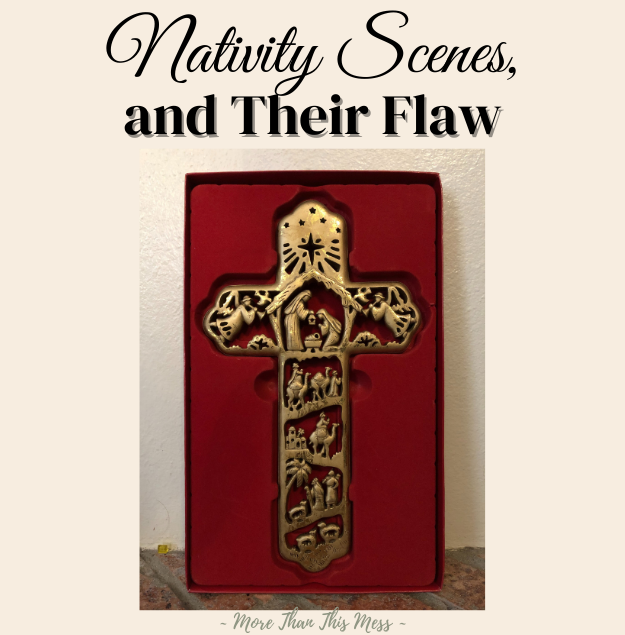
We look at the nativity scene and hear the familiar verses and we feel a familiar sweetness, but we should also be recognizing something much deeper and much better: the God of the universe who lowered Himself to our level. That is a marvel. A wonder. A miracle beyond our full comprehension.
And that should be our focus. As we look at the sweet things and buy the gifts and decorate our trees and watch our movies and bake our treats and sing our carols and enjoy our traditions and love on our families, underneath it all and above it all and through it all should be the knowledge of what our God did in entering our world that way, and why He did it – to take on our plight, to live the sinless life we couldn’t live, and to suffer our consequences in our place so He could offer us His very life.
Eternal life, a gift to us from Jesus.
Because of that, no matter what else is happening, we can truly have a merry Christmas.

More on Christmas:

 More Than This Mess